US launches heavy strikes on Iran after missile attacks
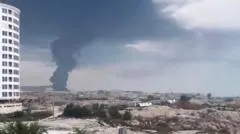
The United States military conducted a significant wave of airstrikes against Iran on Wednesday evening, targeting dozens of Islamic Revolutionary Guard Corps (IRGC) sites. This retaliatory action follows Iran's attempted ballistic missile attacks on American forces in Jordan and on shipping in the Strait of Hormuz earlier in the week. The strikes, which began at 8:00 PM ET and lasted approximately one hour, were described by U.S. Central Command (Centcom) as a "powerful response" to Iran's aggressive actions, aiming to degrade Iran's military command centers, missile and drone facilities, and coastal defense capabilities.
Iranian state media reported that the U.S. strikes resulted in casualties, including a two-year-old child and two adults, in a residential area on Qeshm island. Other locations in southern and western Iran were also hit, according to reports. The escalation marks a dangerous turn in the ongoing conflict, which has seen a breakdown in a ceasefire agreement reached in April and a subsequent period of escalating strikes and counter-strikes since June. The conflict has expanded beyond direct confrontations, with recent joint U.S.-Saudi strikes targeting Iranian proxies in Iraq.
Escalating Regional Tensions
The recent hostilities underscore a broader regional instability. Since the collapse of a ceasefire in April, Iran and the U.S. have been engaged in a cycle of attacks. The U.S. has previously blockaded Iranian ports and struck military sites, while Iran has retaliated with missile and drone attacks against U.S. assets and shipping in the strategically vital Strait of Hormuz. The latest U.S. strikes were a direct response to Iran's firing on a U.S. base in Jordan on Tuesday and its targeting of three oil tankers in the Strait of Hormuz.
Centcom confirmed that all Iranian missiles launched on Tuesday were intercepted. The IRGC, in its statement regarding the Jordan attack, referred to the U.S. as the "child-killing army." The targeting of oil tankers in the Strait of Hormuz, a critical chokepoint for global oil trade, highlights Iran's capacity to disrupt international commerce. The situation has prompted concerns from regional players, with reports suggesting Saudi Arabia, through its defense minister Prince Khalid bin Salman, conveyed a desire to de-escalate tensions to the U.S.
Impact on Civilians and Regional Alliances
The Iranian strikes on Tuesday also extended to Jordan, where air defense systems successfully intercepted five missiles targeting the Kingdom's territory. This marks a rare instance of Jordan, a U.S. ally, being directly targeted during the current conflict. The Egyptian government also reported a drone attack causing a fire at a port, though it has not been directly attacked previously.
Residents in affected Iranian areas described a state of fear and disruption. One man from Qeshm island told BBC Persian about experiencing power outages, internet issues, and loud explosions since early Thursday morning, leading him to seek safety in Tehran. The human cost of the escalating conflict is becoming increasingly apparent, with civilian casualties reported in Iranian cities.
Broader Conflict Dynamics
The current wave of strikes follows a brief pause in intensive U.S. bombing campaigns. Last Friday, the U.S. had suspended a 13-night bombing operation targeting Iranian weapons and military sites, during which scores of people were reportedly killed. The recent joint U.S.-Saudi strikes in Iraq on Tuesday targeted "multiple terrorist logistics and weapons sites across eastern Iraq," according to Centcom, in response to over 30 IRGC-directed drone attacks in the preceding 72 hours.
These strikes in Iraq have drawn condemnation from Baghdad, with the Iraqi presidency denouncing the bombing of Popular Mobilisation Forces (PMF) bases as "an unacceptable attack and a blatant violation of Iraq's sovereignty." The PMF, which is heavily influenced by Iran-backed Shia militias, reported at least 20 of its members killed in the U.S.-Saudi operation. Despite Iraqi objections, U.S. President Trump asserted that the strikes were "co-ordinated with the Iraqi government."
Saudi Arabia's Balancing Act
The ongoing conflict places Saudi Arabia in a precarious position. As a leading Sunni Muslim power, it is engaged in a long-standing regional rivalry with Shia-majority Iran. While seeking to maintain regional stability and its own security, Saudi Arabia also navigates its relationship with the United States, a key security partner. Reports of Saudi Arabia's desire for de-escalation suggest a strategic imperative to avoid being drawn deeper into the escalating U.S.-Iran confrontation. The kingdom's actions and statements will be closely watched as a barometer of regional diplomatic efforts.
The Human Toll
The conflict has taken a significant toll on U.S. military personnel, with over 600 service members reportedly injured since the current phase of the Iran war began in February. This figure underscores the sustained pressure and risk faced by U.S. forces operating in the region. The continuous cycle of attacks and counter-attacks raises serious concerns about the potential for further escalation and its wider implications for regional and global security.
Share this article
Send the story to readers on social or messengers.
Comments
Loading comments…

New Times Reporter Staff
Compiled and edited by the New Times Reporter newsroom from wire and publisher reporting, with the original source credited on every story.