What does a new 1,000-foot moon crater mean for lunar bases?
The Background: Tracking Lunar Impacts
For decades, scientists have monitored the Moon for impacts, primarily using ground-based telescopes and orbital spacecraft. These events, while common across the solar system, are particularly significant on the Moon because its lack of atmosphere means even small meteoroids don't burn up before reaching the surface. The impacts can range from microscopic dust particles to much larger objects. The European Space Agency's SMART-1 mission, which ended in 2006, was one of the first to observe a large impact event directly, creating a crater approximately 15 meters (50 feet) in diameter. More recently, NASA's Lunar Reconnaissance Orbiter (LRO) has been instrumental in mapping the lunar surface and has detected thousands of impact craters, but the recent discovery stands out due to its size and the relatively recent nature of its formation.
The Mechanism: How New Craters Form
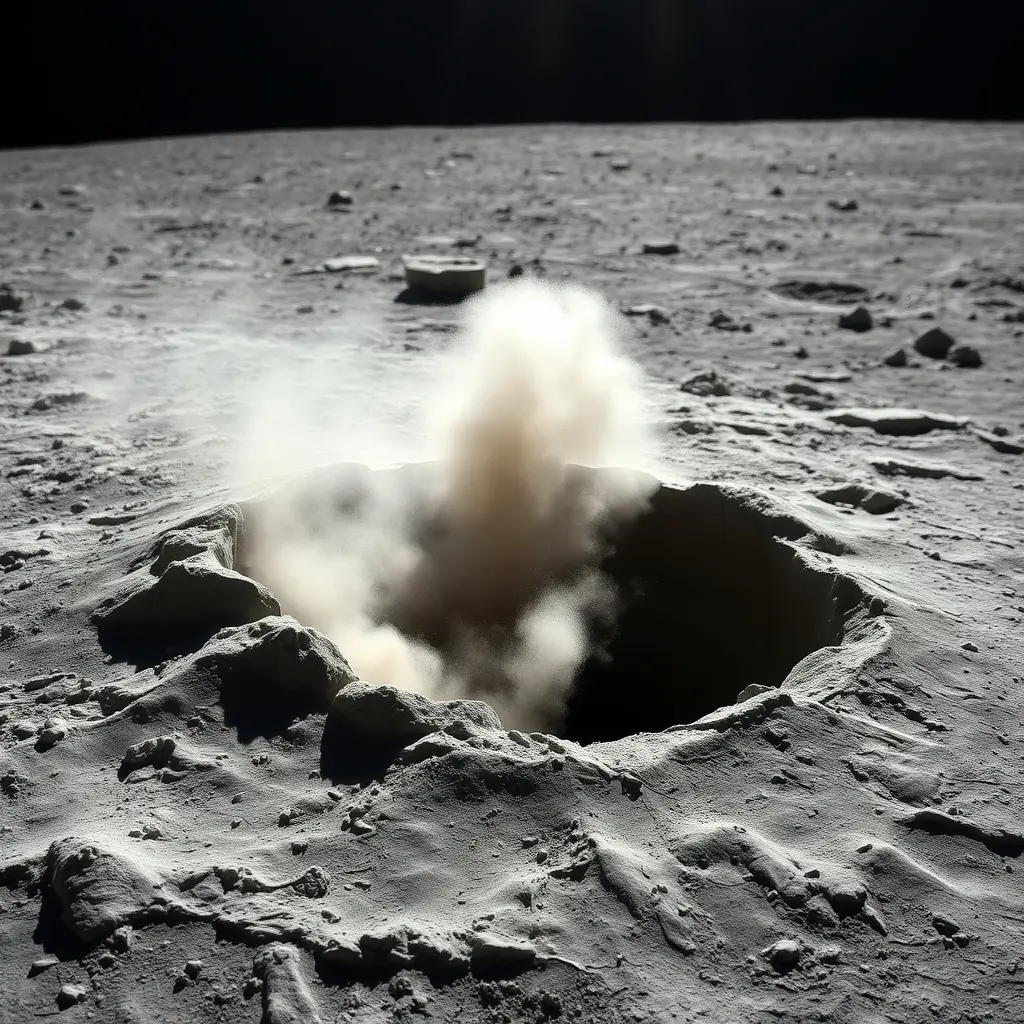
A new lunar crater is formed when a meteoroid, asteroid, or comet strikes the Moon's surface at high velocity. The kinetic energy of the impact is converted into heat and shockwaves, excavating material from below and ejecting it outwards. This process creates a bowl-shaped depression, often surrounded by a raised rim and ejecta blanket. The size and characteristics of the crater depend on the mass, velocity, and composition of the impactor, as well as the geology of the lunar surface at the impact site. In this instance, the impactor is estimated to have been roughly 10 meters (33 feet) wide, striking at an angle that created a particularly large and deep crater, measuring approximately 300 meters (1,000 feet) in diameter. The impact occurred sometime between 2017 and 2021, as detected by the Lunar Reconnaissance Orbiter.
Who is Affected and How, Concretely
This discovery has immediate implications for future lunar exploration and settlement. The creation of a large, relatively fresh crater indicates that the Moon is not a static environment. For astronauts and future lunar bases, such impacts pose a direct hazard. A crater of this size could potentially damage infrastructure, disrupt communications, or endanger personnel if located near a base. The ejected material, or regolith, can also be abrasive and pose a risk to equipment and spacesuits. However, the impact also presents opportunities. The freshly exposed subsurface material could be a valuable resource for scientific study, offering insights into the Moon's geological history and the composition of the lunar interior. It could also provide access to water ice or other volatiles that may have been buried beneath the surface.
What Happens Next, and What Would Have to Be True
The immediate next step involves further analysis of the data collected by the LRO. Scientists will aim to refine the timing of the impact, determine the precise composition of the ejecta, and assess any potential secondary impacts or seismic activity. For future lunar missions, this discovery underscores the need for robust hazard assessment and mitigation strategies. If lunar bases are to be established, sites will need to be carefully chosen to minimize risk from impacts, or protective measures will need to be developed. For example, underground habitats or blast-resistant structures could become standard. The continued monitoring of lunar impacts by spacecraft like LRO will be crucial for building a comprehensive understanding of the risks and opportunities associated with our nearest celestial neighbor. A future where humans establish permanent settlements on the Moon will depend on our ability to predict and manage these natural phenomena.
Share this article
Send the story to readers on social or messengers.
Comments
Loading comments…

New Times Reporter
Editorial coverage from New Times Reporter.