The Empty Square: Russia’s Victory Day Scales Back as Frontline Realities Bite
The rhythmic clatter of tank treads and the intimidating roar of intercontinental ballistic missiles, once the hallmark of Russia’s military prestige every May 9th, will be noticeably absent this year. In a move that signals the mounting strain of a four-year-long conflict, the Kremlin has confirmed that the 2026 Victory Day parade in Red Square will feature no military hardware.
This dramatic scaling back—marking the first time since the invasion of Ukraine began that Moscow will showcase zero heavy equipment—presents a stark contrast to the "muscle-flexing" displays of the pre-war era.
From Might to Minimalism For decades, the Victory Day parade was more than a commemoration of the 1945 surrender of Nazi Germany; it was a carefully choreographed message to the West. However, the optics have shifted from intimidating to improvised. Following the 2024 parade, which became a point of international mockery after Russia displayed only a single, vintage T-34 tank, the decision to remove hardware entirely suggests a logistical and symbolic retreat.
Military analysts suggest that the decision isn't merely atmospheric. The Russian Ministry of Defense is facing a "double squeeze": a desperate need for every operational vehicle on the frontlines and an increasingly porous air defense system that struggles to protect domestic infrastructure.
The Drone War and Domestic Vulnerability While Moscow prepares for a silent parade, the war's intensity is felt elsewhere. Ukraine’s recent defensive statistics are staggering, with Kyiv reporting the downing of over 33,000 Russian drones in March alone. This "war of attrition" in the skies is mirrored by Ukraine’s aggressive "deep rear" strategy.
Just yesterday, a major fire at an oil refinery in Tuapse raged for over 24 hours following a Ukrainian drone strike. It was the third attack on the Black Sea port in less than a fortnight, hitting Russia where it hurts most: its energy revenue. Vladimir Putin has labeled these strikes as "escalations against civilian infrastructure," yet they underscore a growing reality—Russia’s air defenses are being stretched to their breaking point.
International Friction: The Grain and NATO Debates The conflict continues to spill over into the diplomatic arena. President Volodymyr Zelensky has recently turned his attention toward Israel, threatening sanctions over the alleged import of "stolen" Ukrainian grain. This move highlights Kyiv's uncompromising stance on any nation or entity perceived to be profiting from Russian-occupied territories.
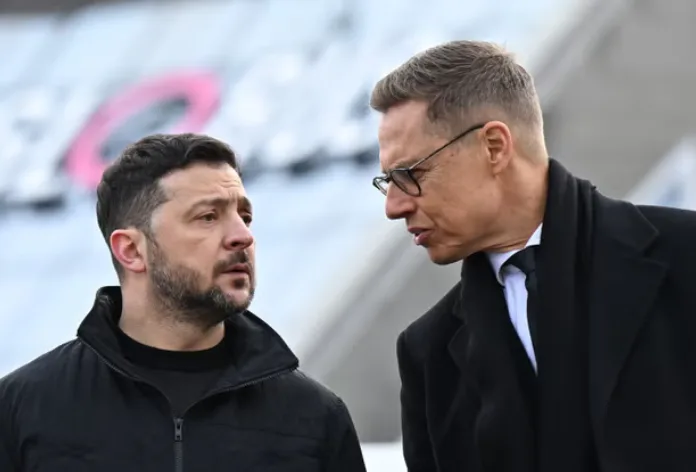
Simultaneously, the geopolitical landscape in the West remains in flux. In a historic address to the U.S. Congress, King Charles III emphasized that the United States "lies at the heart of NATO," a statement many viewed as a direct counter-narrative to isolationist rhetoric. As European leaders like Finland’s Alexander Stubb argue that Europe may now need Ukraine’s battle-hardened military more than the reverse, the "symbolic membership" of Ukraine in Western alliances is evolving into a strategic necessity.
A War of Attrition As May 9th approaches, the silence in Red Square will speak louder than the usual roar of engines. Whether framed as a security precaution or a logistical necessity, the absence of tanks in Moscow is a powerful testament to the current state of the Russian military machine.
In the 1,500+ days since the "special military operation" began, the transition from a global superpower’s display of dominance to a minimalist ceremony highlights a simple truth: it is difficult to parade equipment that is either burning in a refinery or buried in the mud of the Donbas.
Share this article
Send the story to readers on social or messengers.
Comments
Loading comments…

Arthur Sterling
Arthur Sterling covers politics and global affairs with a focus on policy impact and institutional dynamics.