The Trial of the Titans: Musk vs. Altman in the Battle for the Soul of AI
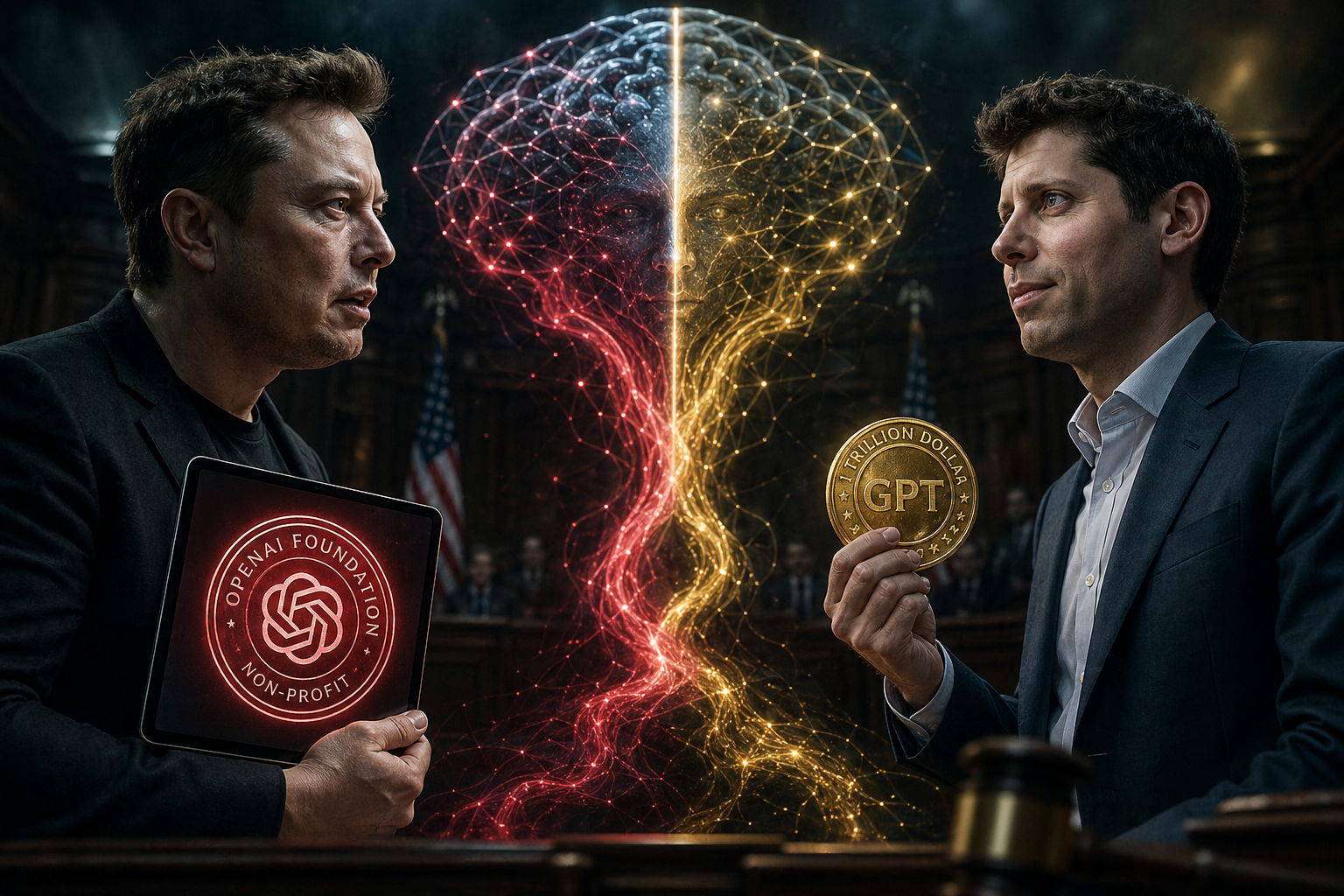
In the cold, clinical fluorescent light of a federal courtroom in Oakland, California, a decade of friendship, ambition, and technological idealism has finally curdled into a legal war. As jury selection begins this Monday, the two men seated at opposing tables represent more than just corporate interests; they represent two fundamentally different philosophies on how the most powerful technology in human history should be governed.
On one side is Elon Musk: the billionaire provocateur who views himself as the frantic guardrail against a digital apocalypse. On the other is Sam Altman: the soft-spoken "Steward of Progress" who transformed a tiny lab into a trillion-dollar juggernaut.
At stake isn't just billions of dollars, but the very definition of "Artificial General Intelligence" (AGI) and whether a promise made to humanity in 2015 can be legally traded for a profit margin in 2026.
I. The Genesis: A Pact in the Shadow of Giants To understand why Musk is suing Altman today, we have to go back to 2015. At the time, the AI landscape was a monoculture dominated by Google. Musk, terrified that a centralized AI monopoly would lead to an "unaligned" superintelligence that could end humanity, teamed up with Sam Altman, Greg Brockman, and others.
Their mission was simple, noble, and written in their founding charter: OpenAI would be a non-profit. It would be "free from financial obligations" to shareholders, ensuring that its primary loyalty remained with the safety and benefit of mankind. Musk was the engine's fuel, pumping over $44 million into the venture to lure the world's top scientists away from lucrative Silicon Valley salaries.
II. The Pivot: When Computing Power Met Capitalism The friction began when the "charity" realized the sheer cost of its own ambition. Building AGI isn't just about smart people; it’s about massive amounts of electricity and thousands of specialized Nvidia chips.
By 2018, the costs were spiraling. OpenAI’s internal documents, now surfaced in court, suggest that the founders reached a crossroads: starve the non-profit and watch Google win, or create a for-profit "capped" subsidiary to attract the billions in venture capital required to stay in the race.
Musk allegedly wanted to fold OpenAI into Tesla to solve the funding gap—a move Altman and the board rejected. This was the moment the bridge burned. Musk walked away in 2018, and a year later, Altman struck a massive deal with Microsoft, effectively turning OpenAI into a "for-profit juggernaut" fueled by Redmond’s cloud infrastructure.
III. The "Shakespearean" Allegations The lawsuit filed by Musk’s legal team reads more like a tragedy than a dry legal brief. They accuse Altman of a "long con," alleging that the non-profit was merely a "mask" used to attract talent and tax-exempt donations, only to be discarded once the technology was valuable enough to sell.
The Three Pillars of Musk’s Case: Breach of Contract: Musk argues that the founding charter was a binding agreement that OpenAI would never prioritize profit over humanity.
Unjust Enrichment: He claims that the equity and billions in valuation were built on the back of his original charitable donations.
The "Disgorgement" Demand: Musk is asking for a court order to strip Altman and others of their profits and return that wealth to the non-profit foundation.
IV. The Defense: The Reality of the AI Arms Race OpenAI and Sam Altman aren't going down without a fight. Their defense, overseen by top-tier legal minds, rests on a pragmatism that Musk himself usually champions: Innovation requires scale.
Altman’s team is expected to testify that the pivot was a mechanical necessity. They will argue that without the for-profit arm, ChatGPT—which now serves nearly a billion users—would never have existed. Furthermore, they intend to present evidence that Musk was not only aware of the for-profit plans but actually encouraged the search for massive capital before his exit.
To the defense, this isn't a case about "ethics"; it’s a case of "Founder’s Remorse." They argue that Musk is simply bitter that the company he left behind became the most important tech story of the century without him.
V. The Nuclear Option: Restoring the Non-Profit If Judge Yvonne Gonzalez Rogers agrees with Musk’s proposed remedies, the result would be a "nuclear option" for the AI industry. Musk isn't just asking for money; he’s asking for a total corporate reset.
Ousting Altman: Musk wants Altman removed from the board.
Unwinding the Conversion: A court-ordered reversal of the 2019 for-profit shift.
Opening the Black Box: Making the current proprietary models (like GPT-4 and beyond) open-source, as the original charter intended.
VI. The Ripple Effect: Why This Matters to You This trial is the ultimate test of Corporate Law in the Age of AI. If a company starts as a charity, can it legally "pivot" to a $852 billion valuation?
If Musk wins, OpenAI might be forced to halt development, potentially allowing competitors or state actors to take the lead in the AI race. If Altman wins, it signals that "Social Responsibility" in tech charters is more of a suggestion than a legally binding contract.
As both men prepare to testify, the world watches. For Elon, it’s a battle for his pride and his vision of a safe future. For Sam, it’s a battle to protect the empire he built from the ashes of a failed non-profit.
The jury doesn't just decide the fate of two men; they decide who gets to hold the keys to the future of human intelligence.
Share this article
Send the story to readers on social or messengers.
Comments
Loading comments…

New Times Reporter Staff
Compiled and edited by the New Times Reporter newsroom from wire and publisher reporting, with the original source credited on every story.