EU Emergency Talks on Ceuta Migrant Surge Amidst Border Row
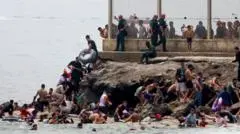
The European Union is convening an emergency meeting on Tuesday to address a significant surge in migrant crossings into the Spanish enclave of Ceuta, an event that has triggered a sharp diplomatic dispute among member states. The crisis, which saw an estimated 60,000 migrants enter Ceuta from Morocco, has prompted 22 EU nations to issue a joint letter calling for coordinated action and enhanced external border security. This collective plea highlights concerns over "hybrid threats" designed to create the perception of easy illegal entry into the EU, a scenario that could encourage further attempts and undermine the bloc's migration policies.
Spain has vehemently condemned what it terms "selfish, polarising and unlawful" reactions from some EU partners, particularly Italy, which suspended its participation in the EU's border-free Schengen arrangement with Spain. Finland and Denmark have backed this move, adding to the escalating tensions. Spanish Prime Minister Pedro Sánchez expressed "serious concerns" in a letter to European Commission President Ursula von der Leyen, accusing unnamed European governments of acting out of prejudice, misinformation, or political motives. He asserted that Spain had swiftly regained control over the border, preventing onward movement towards continental Europe within 48 hours, and noted that Ceuta is not part of the Schengen area.
The influx of migrants, which officials state has largely subsided with almost all having left Ceuta, resulted in a tragic death toll of at least 67 individuals. The situation on July 30, when the surge occurred, led to widespread disruption in the Spanish enclave, though businesses have since reopened. The Spanish Interior Minister, Fernando Grande-Marlaska, confirmed the return to near-normalcy and indicated the development of an inflatable barrier to deter water-based crossings. This incident also highlighted the complex dynamics of the Schengen Area, a zone of 29 European countries facilitating free movement, with some nations now considering or implementing border checks.
Leaders from the Netherlands, Finland, and Belgium are among the 22 signatories of the joint letter addressed to EU officials, including Council President Antonio Costa and Commission President von der Leyen. The letter emphasizes the need to counter perceptions of vulnerability in the EU's external borders. Prime Minister Giorgia Meloni of Italy suspended her country's Schengen cooperation with Spain for a month, a decision mirrored by consideration from France and Portugal. Danish Prime Minister Mette Frederiksen urged the EU to "consider all options, including a suspension of Schengen co-operation," underscoring the gravity with which some member states view the situation.
European Commission President Ursula von der Leyen described the images from Ceuta as "unacceptable," stating on social media that the EU "cannot allow anyone to come to our Union without abiding by our rules." German Chancellor Friedrich Merz demanded that Morocco "take back illegal migrants immediately." In a separate development, UK Prime Minister Andy Burnham reportedly spoke with Sánchez, offering assistance. The situation in Ceuta, one of the EU's two land borders with Africa alongside Melilla, has been a persistent challenge, with significant migrant movements occurring during summer months, often coordinated via social media. In 2021, a similar surge saw approximately 8,000 people enter Ceuta within days, straining diplomatic ties with Morocco.
The Spanish government has generally maintained a relatively open stance on immigration, having approved plans in April to grant legal status to 500,000 undocumented migrants, facilitating their integration into the workforce. However, the recent surge in Ceuta was partly attributed by Spain's Interior Minister to a Supreme Court decision that constrained the government's ability to immediately deport sea arrivals. This incident underscores the ongoing complexities of managing migration flows at the EU's external borders and the varied responses among member states to such challenges.
Ceuta's Strategic Importance
Ceuta, a Spanish autonomous city located on the northern coast of Africa, serves as a critical gateway to Europe. Its unique geographical position, bordering Morocco, makes it a focal point for migrants seeking to reach the continent. The enclave, along with the nearby city of Melilla, constitutes the EU's sole land frontiers with Africa. Migrants often undertake perilous journeys, including swimming several kilometers, to reach these territories. The sheer volume of arrivals, as seen in the recent surge of approximately 60,000 individuals, highlights the immense pressure on these border points and the complex humanitarian and security challenges they present.
Schengen Area Under Scrutiny
The recent events have placed the Schengen Area, a cornerstone of European integration that abolished internal border controls for over 450 million people across 29 countries, under intense scrutiny. Italy's suspension of its Schengen agreement with Spain, and similar considerations by Finland, France, and Portugal, signal a potential fracturing of this open-borders policy. The debate centers on balancing the principle of free movement with the need for robust external border management and national security. The calls for enhanced border cooperation and potential suspensions reflect a growing unease among some member states about the efficacy of current migration control mechanisms and the potential for external pressures to destabilize the zone.
Spain's Response and Diplomatic Stance
Spain has emphasized its commitment to managing the situation and has been critical of what it perceives as unsupportive or even hostile reactions from other EU members. Prime Minister Pedro Sánchez highlighted his government's swift action in restoring border control and preventing onward movement of migrants. The Spanish government's approach, which includes plans to regularize the status of hundreds of thousands of undocumented migrants, contrasts with the more restrictive stances adopted by some of its European partners. The diplomatic fallout from the Ceuta crisis underscores the divergent approaches to migration policy within the EU and the challenges of forging a unified response.
Morocco's Role in Migration Flows
Morocco plays a pivotal role in the migration dynamics affecting Ceuta and Melilla. As the origin and transit country for many migrants attempting to reach Europe, its cooperation is crucial for managing these flows. The recent surge in arrivals has implicitly or explicitly brought Morocco's role into focus, with calls for it to take back its nationals. The country itself has faced internal pressures, including anti-government protests driven by youth seeking better opportunities, as witnessed last year. The complex relationship between the EU and Morocco, particularly concerning migration, remains a key factor in addressing the challenges at the EU's southern border.
The Human Cost of Migration
The migrant crossings into Ceuta have a profound human dimension, marked by loss of life and precarious journeys. The reported death toll of at least 67 individuals underscores the dangers faced by those attempting to reach Europe. The migrants, many of whom are young, are often driven by a desire for better economic prospects and security. The events in Ceuta serve as a stark reminder of the humanitarian crisis unfolding at Europe's borders and the urgent need for comprehensive and humane solutions that address the root causes of migration while ensuring the safety and dignity of those undertaking these journeys.
Share this article
Send the story to readers on social or messengers.
Comments
Loading comments…

New Times Reporter Staff
Compiled and edited by the New Times Reporter newsroom from wire and publisher reporting, with the original source credited on every story.