SpaceX Rocket Set for Unplanned Lunar Impact
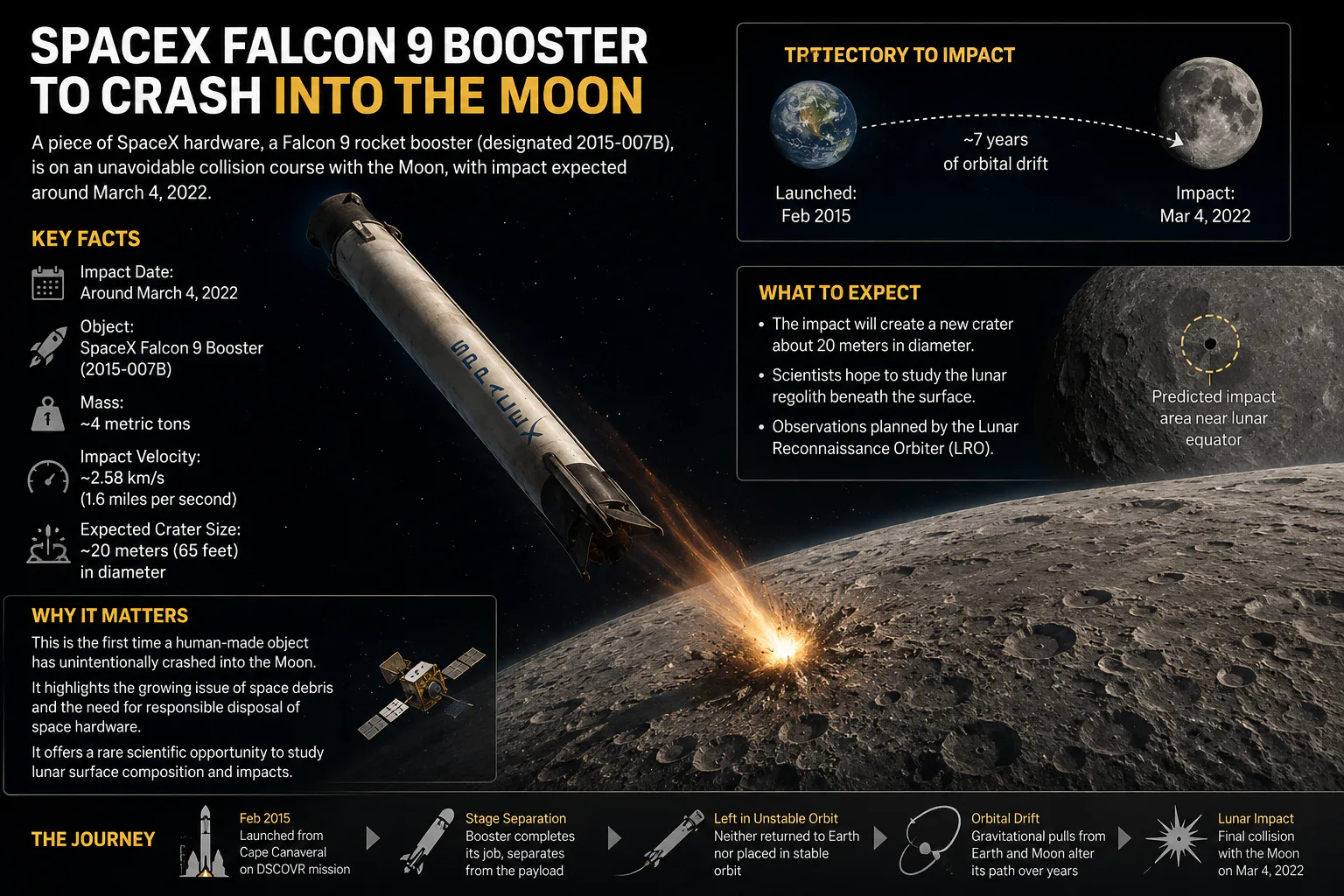
A piece of SpaceX hardware, a Falcon 9 rocket booster, is on an unavoidable collision course with the Moon, with impact expected around March 4, 2022. The booster, designated as object 2015-007B, was launched in February 2015 as part of a mission to deploy the National Oceanic and Atmospheric Administration's Deep Space Climate Observatory (DSCOVR). After completing its primary task, the rocket stage was left in a gravitationally unstable orbit, a common fate for spent boosters. Its trajectory has now been confirmed to intersect with the lunar surface, marking the first time a human-made object has unintentionally crashed into the Moon.
The impending impact has drawn attention from astronomers and space enthusiasts alike, not only for its novelty but also for the potential scientific observations it could yield. While the exact effects of the collision are uncertain, scientists anticipate that the impact will create a new crater, approximately 20 meters (65 feet) in diameter. The booster weighs about 4 metric tons, and its velocity upon impact is estimated to be around 2.58 kilometers per second (1.6 miles per second). The event could offer a rare opportunity to study the composition of the lunar surface beneath the regolith, the loose layer of dust and rock that covers the Moon.
Researchers at institutions such as the Lunar Reconnaissance Orbiter Camera (LROC) at Arizona State University are preparing to observe the aftermath. The LROC team has stated they will attempt to capture images of the impact site using the Lunar Reconnaissance Orbiter (LRO) spacecraft, though the timing and success of these observations depend on the Sun's angle and the LRO's orbital path. The booster's trajectory is not precisely known, making it challenging to pinpoint the exact impact location beforehand. However, models suggest it will strike an area near the Moon's equator.
This incident highlights a growing concern in the space industry regarding the increasing amount of orbital debris. While this particular booster was not intentionally discarded in a way that poses a threat to active satellites, its uncontrolled trajectory underscores the challenges of managing space assets. The booster's journey to the Moon has been a slow one, taking nearly seven years to reach its final destination. Its path has been influenced by the gravitational pulls of both the Earth and the Moon, gradually altering its orbit until a lunar collision became inevitable.
The Falcon 9 booster's fate serves as a stark reminder of the long-term consequences of space missions. Unlike objects in low Earth orbit, which eventually re-enter the atmosphere and burn up, objects left in deep space or unstable orbits can persist for extended periods. The booster's journey has been tracked by independent astronomers, including Bill Gray, who first identified the object and calculated its trajectory. His calculations have been corroborated by other space agencies and observatories, solidifying the prediction of the lunar impact.
While the booster's impact is unlikely to cause any significant damage to the Moon itself, it represents a milestone in space exploration history. It is the first time a significant piece of space debris has been confirmed to be heading for an unplanned lunar impact. The event prompts discussions about the responsible disposal of rocket stages and other space hardware, especially as the frequency of space launches continues to increase globally. The long-term implications of such debris on future lunar missions and the potential for contamination are also subjects of ongoing consideration within the space community.
Future observations of the impact site could provide valuable data on the lunar regolith's properties. Scientists are particularly interested in understanding the depth of the loose material and how it might be disturbed by such an impact. The creation of a new crater, however small, offers a unique opportunity to study these characteristics without the need for a dedicated landing mission. The LRO has previously observed impact craters created by deliberate missions, but an unintentional crash offers a different perspective on the dynamics of lunar surface modification.
The booster's journey began after its launch from Cape Canaveral, Florida. It was part of the Falcon 9 rocket's first stage, designed to propel the payload into orbit. Once its fuel was expended, the stage was intended to either return to Earth for recovery or be placed in a stable orbit. In this case, the booster was left in an orbit that was neither stable nor conducive to a controlled de-orbit, leading to its eventual long drift towards the Moon. This scenario is not unique, and many rocket bodies and other space debris objects currently occupy similar unstable orbits, posing potential future risks.
The scientific community is keen to analyze any data gathered from the impact. The precise location and timing are crucial for maximizing observation opportunities. The fact that the booster is expected to hit the Moon's far side, relative to Earth, adds a layer of complexity to direct observation from terrestrial telescopes. However, the LRO, with its orbital vantage point, is considered the best tool for documenting the event and its aftermath. The potential for a brief flash of light at the moment of impact has also been mentioned, though it is expected to be very faint and difficult to detect.
This event underscores the need for continued monitoring of space debris and the development of international guidelines for space object disposal. As more nations and private companies engage in space activities, the challenge of managing the space environment becomes increasingly critical. The unintentional lunar impact of the SpaceX Falcon 9 booster serves as a tangible, albeit distant, reminder of the growing footprint of human activity beyond Earth.
Share this article
Send the story to readers on social or messengers.
Comments
Loading comments…

New Times Reporter Staff
Compiled and edited by the New Times Reporter newsroom from wire and publisher reporting, with the original source credited on every story.