Why is a Ukrainian drone hitting a Russian beach significant?
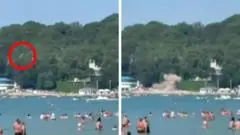
A Ukrainian drone strike on a crowded beach in Arkhipo-Osipovka, a popular Black Sea resort in southern Russia, killed seven people, including three children, and injured 40 on August 3, 2026. The incident, which occurred during daylight hours with tourists present, has intensified accusations between Moscow and Kyiv regarding the targeting of civilians. While Ukraine has not officially commented, some Ukrainian social media channels suggested the drone may have crashed due to electronic jamming, a claim Russian authorities dispute, pointing to eyewitness accounts of gunfire possibly indicating air defence attempts. This event underscores a broader pattern of escalating drone warfare impacting civilian areas in both nations since Russia's full-scale invasion of Ukraine began in February 2022.
The attack on the beach near Arkhipo-Osipovka, a destination favoured by Russians due to curtailed international travel, highlights the increasing reach of Ukrainian drone operations deep into Russian territory. The Krasnodar region governor, Veniamin Kondratyev, explicitly accused Ukraine of a "deliberate strike on civilians." This assertion comes amidst a backdrop of reciprocal accusations; Russia has consistently been accused of targeting civilian infrastructure and residential areas in Ukraine, resulting in thousands of casualties. Ukraine, in turn, has been conducting strikes on targets within Russia, including energy facilities and commercial warehouses, which Kyiv claims are used to support the Russian military. The drone's precise target remains unclear, but the incident amplifies concerns about the safety of civilians in areas perceived as secure and the potential for unintended consequences in the ongoing conflict.
The Background: Escalating Drone Warfare
Since Russia's full-scale invasion of Ukraine in February 2022, both sides have increasingly employed drones for reconnaissance and attack. Initially, Russia used drones extensively for surveillance and precision strikes. However, Ukraine has developed and deployed its own drone capabilities, demonstrating a growing capacity for long-range strikes into Russian territory. These strikes, which have intensified over the past year, have targeted military infrastructure, logistical hubs, and energy facilities. The Ukrainian government asserts that these targets are legitimate military assets, often used to support Russia's war effort. For instance, warehouses belonging to the online retailer Wildberries have been repeatedly targeted, with Kyiv claiming they are used to supply the Russian military, a claim Moscow denies. Despite these denials, the platform has sold items ranging from body armour to components with drone-production applications, blurring the lines between civilian and military use. The drone strike on the beach in Arkhipo-Osipovka is part of this evolving conflict dynamic, where the geographical boundaries of the war appear to be expanding, and the risk to civilian populations on both sides is increasing.
The Mechanism: How the Attack Likely Occurred
The precise sequence of events leading to the drone strike on the Arkhipo-Osipovka beach remains subject to conflicting accounts. However, based on eyewitness reports and the nature of drone warfare, a likely scenario involves a Ukrainian drone, possibly modified for attack, being launched towards the Russian coast. Social media footage verified by the BBC shows a drone descending rapidly before impacting the beach in a fireball. Eyewitnesses reported hearing gunfire preceding the explosion, suggesting that Russian air defence systems may have attempted to intercept the drone. If an interception was attempted, the drone could have been damaged, causing it to deviate from its intended course or detonate prematurely. Alternatively, some Ukrainian sources have suggested that electronic warfare measures employed by Russia could have jammed the drone's navigation system, leading to its uncontrolled descent and crash. The absence of air raid sirens, as reported by some locals, could indicate that the threat was detected too late or that the drone was not initially identified as a hostile aircraft until it was in close proximity to the populated area. The final impact on the beach, rather than a more strategic military target, could be a result of a failed interception, system malfunction, or a deliberate, albeit devastating, diversion.
Who is Affected and How, Concretely
The most immediate and tragic impact of the drone strike is on the seven individuals killed, including three children, and the 40 injured, 17 of whom required hospitalization. These are ordinary Russian civilians, holidaymakers and residents of Arkhipo-Osipovka, who were enjoying a day at the beach. The attack has instilled fear and trauma, particularly among families with children, as one witness described their child having a "nervous breakdown." For the wider population in Russia, this incident serves as a stark reminder of the war's proximity and the potential for civilian casualties even in seemingly safe, recreational areas. It disrupts the sense of security and normalcy that many sought in domestic tourism, especially given the limitations on international travel. For Ukraine, while not commenting directly, such incidents, if successful in striking Russian territory, are intended to demonstrate Kyiv's ability to project force and inflict costs on Russia, thereby pressuring Moscow to reconsider its military actions. However, the deliberate targeting of civilians, whether by Russia in Ukraine or by Ukraine in Russia, carries significant ethical and legal implications and risks further international condemnation.
What Happens Next, and What Would Have to Be True
Following this incident, several outcomes are possible. Firstly, Russia is likely to increase its air defence capabilities along its Black Sea coast and other popular tourist destinations. This would require further investment in military hardware and personnel, potentially diverting resources from other fronts. Secondly, both sides may intensify their rhetoric and propaganda efforts. Russia will likely use this event to further demonize Ukraine and justify its own military actions. Ukraine, if it confirms responsibility, will likely frame it as a legitimate response to Russian aggression. For the international community, this incident could lead to renewed calls for de-escalation or, conversely, increased support for Ukraine's defensive capabilities, depending on the prevailing geopolitical climate. If Ukraine continues to successfully strike targets deep within Russia, it would have to maintain and enhance its drone technology, overcome Russian electronic warfare, and secure supply lines for its drone program. If Russia retaliates with increased strikes on Ukrainian civilian areas, it would signify a further disregard for international humanitarian law and could lead to more severe international sanctions. The long-term impact will depend on whether such strikes become a more frequent occurrence, forcing a strategic reassessment by either side, or remain isolated incidents within the broader conflict.
Share this article
Send the story to readers on social or messengers.
Comments
Loading comments…

New Times Reporter
Editorial coverage from New Times Reporter.